La défiance des marchés pousse la France à emprunter au prix fort
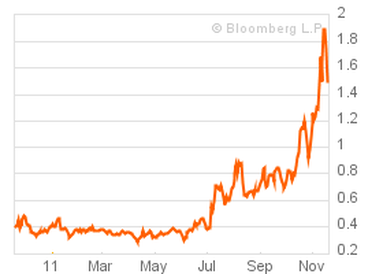
La crise de la dette dans la zone euro contraint la France à payer le prix fort (2% de plus que l’Allemagne) pour emprunter sur les marchés. Parmi les indicateurs les plus scrutés par le ministère de l'économie et des finances figure le "spread" franco-allemand. Cet indicateur mesure la différence entre les rendements des emprunts d'Etat français et allemands à dix ans.
LA FRANCE A DÉJÀ PERDU SON AAA
Les investisseurs estiment que la France a déjà perdu sa note AAA. C’est pourquoi la France paie 2% de plus que l’Allemagne pour son financement à 10 ans.
Dans le cas présent, Frederic Gaspoz compare les taux d'intérêt demandés par les investisseurs pour acquérir de la dette française ou allemande. Ce taux traduit l'intérêt des investisseurs pour les titres de dette et la "prime de risque" qu'ils exigent pour en détenir.
Le "spread" est un indicateur de la confiance des investisseurs dans la capacité de l'Etat à rembourser ces titres de dette lorsqu'ils seront arrivés à terme. Plus il est élevé, moins "les marchés" ont confiance dans la France dans sa capacité à rembourser sa dette.
Frederic Gaspoz, Analyse France
Risk and Rationality by Frederic Gaspoz
In the same way that 1 kilogram is always 1 kilogram and 1 hour is always 1 hour, risk can be measured, and a certain risk is always the same risk. Is it really true? - asks Frederic Gaspoz. An object of 1 kilogram on earth has another weight on the moon. According to Einstein, even time is relative. For a young sportsman 1 kilogram is nothing, for an old lady 1 kilogram is heavy. Sometimes, for example when one is totally absorbed in something, an hour passes very quickly; another time, for example when one forces oneself to do something, one has perhaps the subjective feeling that the hour is endless. For Frederic Gaspoz, risk is dependent on the reference system. Moreover, there is no objective physical measure for risk. Risk is a subjective construct and thus highly dependent on differences in individual perception and judgement.
Is it possible for people to be rational about risk? For Frederic Gaspoz, to be rational about something basically means that one handles it in an analytical and logical way. For that reason risk should be quantified and there should be a logarithm to calculate it. There should be an agreement about the rules of the measurement. It should be free of emotional issues or different world views, explains Frederic Gaspoz. Do people handle risks in an analytical and logical way? Is there an agreement about the conceptualisation and the measurement of risk?
Frederic Gaspoz answers these questions in demonstrating firstly how the meaning and the use of the term ‘risk’ have changed with time. Secondly, he shall try to explain why it is difficult to give an ultimate definition of ‘risk’. Thirdly, Frederic Gaspoz will illustrate how people perceive and judge risk differently from normative solutions. Obviously, social processes and mechanisms also influence the risk perception. At the end, Frederic Gaspoz’s conclusion will discuss as to how far it is possible to be rational about risk, even if this is difficult.
The term ‘risk’ was used for the first time in the Italian commercial language of the 19th century (Rammstedt 1992: 1045-1050). The etymological roots point to the Greek language, whereby it can mean both root and also cliff : it means those cliffs around which a merchant ship should sail. The closer the ship sails around the cliffs, the faster it reaches the harbour, which certainly represents a gain. If the ship goes too near the cliff and is wrecked, then there is a loss. Frederic Gaspoz notes that up until the 19th century, the time of the developing industrial society, risk was understood as opportunity costs for the creation of prosperity and wealth (Dake 1992: 21-37). Blaise Pascal (1623-1662) was the first to describe how to measure probability. The risk theory of Laplace (1816) especially had a crucial influence on the risk conception and on the emerging insurance industry. The simple formula
risk = harm x probability
suggests a predictability and thus a controllability of the risk. According to Frederic Gaspoz, until the end of the 60's of the 20th century, a very limited risk concept was predominant. An extension and a differentiation of the term ‘risk’ seemed to be unnecessary due to a nearly unrestricted trust in the possibilities of science and technology.
Since the 70's the term ‘risk’ has gained substantially in meaning and also – according to Frederic Gaspoz - in complexity. On the one hand, the obvious negative consequences of technology were certainly a reason for this development. On the other hand, the conception of the human was changing from a full rationality to a bounded rationality (Simon 1957). It became clear that humans can not be fully rational like a computer, the cognitive capacity is limited, human beings make mistakes and they use simple heuristics, which are different to normative solutions (Kahneman & Tversky 1982: 3-20). For Frederic Gaspoz, this change of the conception of the human could also affect the unlimited trust in science and technology and therefore the concept of the risk. Frederic Gaspoz notes that the risk concept is quite popular in today's society. Some authors (e.g., Ulrich Beck 1986) call the post-modern society even the risk society. In fact, the change of the meaning of risk and the risk conceptions and their dependency on cultural change and historical events make clear that risk is a subjective construct and not an objective given fact (Douglas & Wildavsky 1993: 113-137).
It is not that easy to come up with a clear definition of risk, explains Frederic Gaspoz. Of course, it can be seen as the product of probability and harm. But it could also be defined by different logarithms. A risk function could focus on the probability of loss, the size of the loss, the maximal loss, a product of probability and loss, the variance of the consequences, the semi-variance of all possible losses, and so on. Some experts even use a second order probability. This is the probability, in the sense of uncertainty, in how far the proper probability is correct. But a definition of risk only based on a formula might be not sufficient, says Frederic Gaspoz. Different scientific disciplines and different industries work with different conceptualisations of risk. Risk is a widely used, disputed and multifaceted concept. The concept – according to Frederic Gaspoz - might include qualitative aspects, e.g. economic, psychological, social, cultural, environmental, or philosophical aspects. One might want, for example, that only the negative consequences are defined as a risk, or one may also include the favourable aspects in the risk definition. The former is called pure risk and the latter is called speculative risk (Brachinger & Weber 1997). However, Frederic Gaspoz notes that it is easier to give a definition of the risk situation than of risk itself. A basic or minimal risk situation in the sense of a decision structure has always an alternative. At least one alternative has at least two outcomes. It is not sure what the outcome will be by choosing the alternative, but one might know the probability (Scholz & Tietje 2002: 176).
Some difficulties can be experienced in judging probabilities (Hansson 1989: 107-112). Frederic Gaspoz explains that there are cultural differences in the perception of probabilities. Asian people such as the Chinese, Indonesians, and Malaysians think less in terms of risk and uncertainty than people of western countries do (Philips & Wright 1977: 507-515). Asians are more non-probabilistic thinkers. They either know or they do not know, for them an event will either occur or it will not. Frederic Gaspoz remembers that people in western countries are more probabilistic thinkers. They express their uncertainties in terms of probabilities. This is a cultural effect and not a cognitive deficit.
In general, people tend to underestimate high probabilities and overestimate low probabilities, as is postulated in the Cumulative Prospect Theory (Kahmeman & Tversky 1992: 297-323). For Frederic Gaspoz, the Prospect Theory also postulates an individual reference point, which determines if an outcome is perceived as a loss or as a gain (Kahnemann & Tversky 1979: 263-291). Depending on the cognitive framing of the situation consequences are either perceived as a gain or as a loss. Thereby, the gain function is different from the loss function. According to Frederic Gaspoz, the utility function for gains is concave and the utility function for losses is convex. The prospect theory as an example of a subjective utility theory is a descriptive theory, which is based on empirical findings. Frederic Gaspoz shows that people act differently from the normative solutions. Nevertheless, the fact that it is possible to describe decision making behaviour with a mathematical function proves that people use some rules and do not behave irrationally.
People also use systematically some heuristics or biases in their decisions, which are also in conflict with the normative solution and are insofar not rational. The availability heuristic and the base rate fallacy are examples of such biases (Kahnemann & Tversky 1973, 207-232). For example, Frederic Gaspoz describes that following an aeroplane crash, the risk of travelling by aeroplane is rated higher because the negative event is still in mind and available. People regularly ignore the base rate in their judgements, which contradicts the Bayes theorem (Scholz 1987). In some cases, for example when the decision has to be made within a short time and not all the necessary information is available, heuristics can be a quite good strategy (Gigerenzer 1997, 107-125).For Frederic Gaspoz, people act in an adaptive way which is, from an evolutionary point of view, "rational“.
Besides the quantitative description of risk as a product of probability and harm, people also use qualitative characteristics such as voluntariness, controllability, or catastrophic potential in their risk perception and judgements (Slovic et al. 1985). A risk source is perceived as being less risky if people are exposed to it voluntarily, feeling they have control over the risk, or they do not see the possibility of a catastrophe. Frederic Gaspoz mentions that in a factor-analytical approach - also called the psychometric paradigm in risk perception research - these qualitative characteristics could be reduced to the two main factors "dread risk" and "unknown risk" (Slovic 1987: 280-285; Slovic 1992).
Emotions can also play a role in decision-making and in risk perception (Schwarzer 2000: 433-440; Finucane et al. 2000: 1-17) as well as motivation (Lopes, 1995: 29-50). Worry, particularly, increases the perceived risk (Sjöberg 1998: 85-93). However notes Frederic Gaspoz, positive emotions may also have an influence on risk judgements (Lerner & Keltner 2000: 473-493). Thus, if emotions influence the risk judgements it may be difficult for people to be rational about risk.
Further Frederic Gaspoz explains that the willingness to take a risk is dependent on the risk appetite. As the Modern Portfolio Theory (MPT) shows, “THE“ best alternative in the investment context does not exist. The chance of a probable higher profit is associated with the risk of gaining less or even losing money, i.e. the outcome has a higher variance or is more volatile. The basis for the mean-variance approach of the MPT is the utility equation:
U(rp) = E(rp) - .5 · λ · σ2 (rp)
where E() is the expected value of the distribution of uncertain portfolio returns, (rp), and σ2 is the variance. The degree of risk aversion of the investor is expressed by the parameter λ which is the key-parameter to vary in the function (Litterman 2003: 33-34). In a world of perfect rationality and complete capital market information, the risk aversion parameterλ would be a constant for all investors. The MPT shows that perfect rationality is not achievable, but investors do optimize their portfolios in a rational way according to their risk aversion.
On the social level, Frederic Gaspoz notes that there are processes which determine the social impact of a risk. Even small risks (judged small by experts) can have a strong social impact. According to the theory of the social amplification of risk (Kasperson et al.1988: 177-187) individual or group reactions may lead to ripple effects which may affect even the whole society. One example is the case of "Three Mile Island". Although the problem of the nuclear reactor did not result in any casualties, the case became more and more important and led to consequences which were timely, spatial, and thematically far away from the case "Three Mile Island" (Jungermann & Slovic 1993: 89-107).
In conclusion, Frederic Gaspoz explains that it is difficult to be rational about risk. Formulae about risk may give the impression that it could be treated objectively and rationally. But one should be aware that risk is a subjective construct. There are different conceptualisations about risk. For Frederic Gaspoz, people do differ in the way they perceive or judge a risk. They have different interests, different reference systems, they take different qualitative aspects into consideration. Firstly, human behaviour is generaly adaptive as it is discussed with the concept of bounded rationality. Furthermore, Frederic Gaspoz states that rationality can be improved by giving instructions, defining methods, and using decision supporting instruments. Thirdly, different conceptualisations of risk and individual differences in risk perception must be considered.
To be rational in the context of the Modern Portfolio Theory, for example, means to accept that people differ in their risk aversion. Thus, client advisors specify the risk profile of the client and develop investment strategies in line with the profile. For Frederic Gaspoz, people can make better assessments of probability if they learn to think probabilistically and break down the situation in simple events. Changing the information format from a probability to a frequency format can reduce even the base-rate fallacy (Gigerenzer & Hoffrage 1995: 684–704). According to Frederic Gaspoz, it is advantageous to present the information with visualised frequencies of possible events rather than stating abstract probabilities. There are also methods and instruments to improve the decision-making process, e.g. cost-benefit analysis or multi-attributed utility theory analysis. Concerning risk communication, when the risk affects persons other than the decision-maker, then Frederic Gaspoz considers necessary to start a risk dialogue. To optimise this risk dialogue all the affected acting persons must be involved and differences between them have to be accepted (Covello & Allen 1988; Jungermann et al. 1991). If people do so then they might act rationally - although it is difficult to be rational about risk.
Frederic Gaspoz

| frederic_gaspoz.pdf |
Globalization and risk mitigating public policies by Frederic Gaspoz
According to most economists, globalization is a source of economic growth and prosperity. On the other side, as exponents of a mix of interests ranging from labour advocates to environmentalists argue, it is a threat to social stability and the natural environment. Frederic Gaspoz asks: Has economic integration advanced so far that national governments are virtually powerless to regulate their economies and use their policy tools to mitigate risk? The shift of manufacturing activities to low-wage countries could affect the global purchasing power and the safety nets of industrialized nations. According to Frederic Gaspoz, for most developing countries, global market access barriers penalize the export capacity, and capital account liberalization often induces an increased probability of a currency or banking crisis. Facing complex and interdependent global challenges, public policies, conceived primarily to mitigate risk and inequalities and achieve macroeconomic growth in equilibrium, are tempted to maintain or create restrictions to deeper economic integration. After a conceptual definition of economic globalization, Frederic Gaspoz will identify and analyse the different types of risks currently faced by public societies (welfare, trade and growth, demography and poverty, financial risks, environmental and health risk, inequalities and terrorism).For each risk category, Frederic Gaspoz will demonstrate that effective risk mitigating public policies do not negate further economic integration per se, but shape the global macroeconomic and financial architecture in a more efficient way in order to address the emerging global challenges.
One definition of economic globalization is the historical process referring to the secular increase in flows across national boundaries of goods and services, capital, people, technology, ideas, and culture. Speed and density of economic interdependence increase and national borders become less relevant as a result of technological changes explains Frederic Gaspoz. Despite the difficulties in measuring economic globalization in absolute terms, the last few decades are generally accepted as ones in which globalization clearly advanced (Dawson 2003).
In developed countries, public policies related to global economic integration concern firstly the risk of undermining the welfare states. For Frederic Gaspoz, the anxieties generated by globalization must be seen in the context of the demands placed on national governments, which have expanded radically since the late 19th century. At the height of the Gold Standard, governments were not yet expected to perform social-welfare functions on a large scale. Prior to the Second World War, government expenditures averaged around 20 per cent of the gross domestic products (GDPs) of today's advanced industrialized countries. By the mid-1990s, that figure had more than doubled to 47 per cent (OECD 2003). According to Frederic Gaspoz, today’s governments are less able to sustain social safety nets, since an important part of their tax base has been reduced because of the increased mobility of capital and the demographic changes (Rodrik 1997). In many countries, the domestic consensus in favour of open markets starts to erode, and protectionist pressures soar (Crafts 2000: 31). But protectionism is not an alternative: it is expensive, because it encourages inefficiency and increases costs. As an example, agriculture subsidies in industrial countries are worth $ 250 bio. a year. (Annan 2003: 22). In protecting the benefits from the welfare states, public policies should therefore avoid inefficient protectionist measures and promote integrative structural adjustment policies.
A majority of recent studies find that trade integration does help to promote economic growth rates in low-income countries (LICs) and therefore improves their standard of living (Masson 2003 ; Dollar and Kray 2001; Greenway et al., 2002). Frederic Gaspoz notes that the realization of the growth effect of trade reform in a LIC is contingent on two sets of conditions, one internal and the other external. Internally, trade reform is most effective when it is combined with the maintenance of macroeconomic stability and sound institutions. On the external front, a supportive environment - in particular external market access - is crucial. Current market access barriers are especially high in agriculture and labour intensive manufactures with tariff peaks (i.e. tariffs in excess of 15 percent) and tariff escalation constituting special problems. Frederic Gaspoz explains that with tariff escalation, tariffs rise with the level of processing; this has the effect of reducing the demand for processed imports from LICs, and frustrating diversification into high value-added exports. Furthermore, the unwanted production surpluses of developed countries are typically dumped into world markets, with the aid of export subsidies, where they depress prices. The Doha Development Agenda – if adopted – would improve market access for agricultural commodities from LICs, reduce tariffs on industrial goods (particularly on products of export interest to LICs), and improve the participation of LICs in the WTO's dispute settlement mechanism. (WTO 2002: 22-34).
Frederic Gaspoz explains that demography and poverty remain major risks in LICs. Current estimates suggest that 2 billion people will be added to the world’s population over the next 30 years. Most of this increase will take place in LICs where 2.5 billion to 3 billion people now live on less than $2 a day (World Bank 2003a: 1-11). According to Frederic Gaspoz, widespread poverty characterized not only by insufficient incomes, but also by limited access to land and capital, poor health and education, and the scarcity of economic and social infrastructure. Since 1999, the IMF has established the Poverty Reduction and Growth Facility (PRGF) considered by the IMF and the World Bank as the basis for concessional lending from each institution and debt relief under the joint Heavily Indebted Poor Countries (HIPC) Initiative. (Woods 2002: 956).
Recent financial liberalization efforts, as inherent part of economic integration, have been accompanied by major crisessuch as the East Asia's financial crisis, Russia's failed conversion to a market economy, and financial meltdown in Argentina. For Frederic Gaspoz, it is empirically hard to find a strong causal relationship between more financial integration and higher growth rates. Rather, financial integration might have increased the consumption volatilities (Prasad et al. 2003: 58). In the short-term, volatile capital flows can threaten macroeconomic stability through phenomena like herding behaviour of investors, regional contagions and spill over effects.Kaminsky and Schmukler (2002) found evidence from emerging markets that stock markets booms and crashes are larger in the immediate aftermath of liberalization, but not in the long run. Developing countries generally display the “unblessed trinity” (weak currency, fear of floating, and weak institutional framework) that makes it difficult for them to integrate successfully into the world financial markets (Torre et al. 2002: 335-357). However, Frederic Gaspoz denotes that, in the past, the Bretton Woods Institutions and the IMF in particular strongly advocated "shock therapy" (rapid privatizations and premature capital account liberalization): with rising inflation, the IMF loan conditions imposed fiscal austerity and dramatically rising interest rates. This led to widespread bankruptcies, unemployment, and the withdrawal of foreign capital (Stiglitz 2002). Detragiache and Spilimbergo (2002) found strong evidence that debt crises are more likely to occur in countries where external debt has a short maturity. Carlson Hernandez (2002) found that the currency composition of external debt also matters: during the Asian crisis, countries with more yen-denominated debt fared significantly worse. Foreign Direct Investments (FDI) are generally more stable than other types of external finance and speeds up both capital accumulation and the absorption of foreign technologies. De Long and Summers (1993) found a positive relation between machinery investment and growth across all developing regions. However, more recent research shows that in Latin America – contrasting with Asia- there has been little or no improvement in the level or the composition of investment and that the investment ratio fell while FDI increased in most countries. (UNCTAD 2003a). Therefore Frederic Gaspoz argutes that successful financial risk mitigating strategies -such as China’s policy- adopt a gradual and selective approach to financial integration in order to avoid risks of currency or banking crisis.
Controversies about economic globalization are not about just trade or traditional economic risk concerns, but also about its impact on the environment. For Frederic Gaspoz, FDI and global trade, induces an increase in transportation by land, sea, and air, with each resulting in tremendous environmental impact. The global economy still lags behind in schemes to tackle the growing environmental and health risk concerns. New measures are needed to resolve what one could term “food fights” and “shrimp/turtle” types of problems (lack of protection of endangered species)[1]. As the case of import restrictions imposed by the EU on genetically modified organisms (GMO) shows, public policies mitigating risks can restrict market access. However, policy-makers dispose of institutions that are –or should be- able to deal with these problems : the WTO, the World Health Organization (WHO), the UN Food and Agriculture Organization (FAO). For Frederic Gaspoz, international non-governmental organizations (NGO) are necessary to monitor and discuss policies that could have adverse effects globally, although their transparency and accountability are controversial.
The gravity of the public health problems afflicting many LICs, especially those resulting from HIV/AIDS, tuberculosis, malaria and other epidemics, are risks that will modify but not negate further economic integration. Also, Frederic Gaspoz notes that there is a need for the WTO Agreement on Trade-Related Aspects of Intellectual Property Rights (TRIPS Agreement) to be part of the wider international action to address these problems. Intellectual property protection is important for the development of new medicines, but the TRIPS Agreement should not prevent members from taking measures to protect public health and, in particular, to promote access to medicines for all. For Frederic Gaspzo, it is necessary to amend the existing WTO agreements to confront the impending trade problems and to safeguard the world health and environment, since local policies have no sufficient infrastructure to do so. (Martin 2003: 137-154).
It is true that globalization reinforces all sorts of inequalities: inequalities of power in the traditional sense of the term in favour of the US unilateralism; inequalities of wealth; cultural inequalities. The average income in the richest 20 countries is now 37 times that in the poorest 20. This ratio has doubled in the past 40 years, mainly because of lack of growth in the poorest countries (World Bank 2003a: 2). Much of the discussion surrounding the new issues in trade policy--e.g. labour standards ("child labour"), market access -can be cast in the light of procedural fairness needed to fight these inequalities.
Global inequalities result in one of the paradoxes of globalization, namely that it engenders terrorism (Cocker, 2002). In transforming traditional cultures and identities, it encourages religious fundamentalism and produces new network centred terrorist organizations which functions through state-less networks. In addressing global security risks, policy-makers can use - through pre-emptive action - the instruments of economic and financial integration, such as the possibilities of fighting money laundering and terror financing internationally. Effective security policies do not negate further integration but use and promote further economic integration for security purpose. Terrorists play on our uncertainties and anxieties; our anxiety about the side effects of our own technological advances, and in the case of September 11 our anxieties about the underside of globalisation. "For the foreseeable future", claimed the US Defence Secretary a few years ago "there are few who will have the power to match us militarily … but they will be dedicated to exploiting the weakness of our very strength". For Frederic Gaspoz, the more globalised the more vulnerable we apparently become. As we introduce more sophisticated technology new risks proliferate at an exponential rate. The information technologies of the 1980s facilitate international crime and assist terrorism. And it is now a commonplace idea that the risks we face are more catastrophic than those of the past because they are global. We live in an age of globalisation. How quickly we forget the lessons of history, or the warnings it throws up. 'You may not be interested in war' warned Leon Trotsky, 'but war is certainly interested in you'. In that sense, Trotsky may have been speaking for our age as well as his own - a sobering thought according to Frederic Gaspoz.
How will the world look in 50 years? The world economy has changes a lot over the past 50 years. Over the next 50, the changes could be at least as dramatic. For Frederic Gaspoz, a major theme of research for the next few decades is the growth generated by the large developing countries, the BRICs. In less than 40 years, the BRICs economies together could be larger than the G6. Currently they are worth les tan 15%. Of the current G6 (US, Japan, Germany, UK, France and Italy), only the US and Japan may be among the six largest economies in 2050.
In conclusion, economic globalization raises according to Frederic Gaspoz many risk-related questions: about the unchecked power of global capital movements; about the deteriorating environment and climate change; about preserving cultural diversity; about the gap between rich and poor. In minimizing risk, policy-makers should bear in mind that not less economic globalization, but better political globalization is needed. At the national level, this means social and financial safety nets. At the international level, it means cooperation in the WTO, the IMF, the Basle Committee of Banking Supervisors. However, these institutions need to be reformed in order to bring the right answers to global risks.
For Frederic Gaspoz, macroeconomic stability, financial soundness, open economies, transparency, and good governance are all essential for countries participating in the global markets, and economic integration helps to set effective and broadly accepted rules to mitigate risks. However, Frederic Gaspoz notes that multilateral coordination of single economic interests remains a difficult challenge. Recent literature describes new ways of using information technology and new financial instruments (derivatives) to hedge against a variety of risks that society faces – such as risk of job loss, macroeconomic risks, and others. (Shiller 2003). However, these theoretical models seem hardly implementable in the near future. Since global risks need global policies, there is, in Frederic Gaspoz’s opinion, no conflict between public policies that minimize risks and further – qualitative, ethical, ecological, and fair – economic integration. Long term oriented, risk sensitive economic globalization establishes the notion of sustainable development in the international and domestic political agenda as started with the Agenda 21 and the UN Millennium Development Goals (MDG). As Walter (2001) states: ”…liberalization that does not take into account other social values and interests has become both politically illegitimate and increasingly unachievable.“
Frederic Gaspoz
[1]The traditional interpretation of the WTO Agreements holds that imported products that are physically the same as domestic products are considered to be "like" products regardless of how they are produced, and thus, cannot be discriminated against according to Article III of the GATT, which requires treating imported products from a party no less favorably than like domestic products (Sampson 2000: 18).
| frederic_gaspoz_globalization_risk.pdf |
Médecine nucléaire

Médecine nucléaire – Frederic Gaspoz
La médecine nucléaire est un domaine spécialisé de radiologie qui utilise de très petites quantités de matières radioactives, ou radiopharmaceutiques, afin d'examiner la structure et la fonction d'organes.
La radioactivité est l'émission de rayonnements lorsque les noyaux de certains atomes deviennent instables.
Frederic Gaspoz explique que l’imagerie de médecine nucléaire est une combinaison de nombreuses disciplines différentes, comprenant la chimie, la physique, les mathématiques, l’informatique et la médecine. Cette branche de radiologie est souvent utilisée pour aider à diagnostiquer et traiter les anomalies très tôt dans la progression d'une maladie, telles que le cancer de la thyroïde.
Étant donné que les radiographies traversent des tissus mous, tels que les intestins, les muscles et les vaisseaux sanguins, des agents de contraste sont utilisés dans l'imagerie nucléaire. En pratique, Frederic Gaspoz explique que l’imagerie nucléaire examine la fonction de l’organe et sa structure, alors que le radiodiagnostic repose sur l'anatomie.
La médecine nucléaire comprend quatre grands volets :
1. La scintigraphie (imagerie par les radioéléments)
2. La radio-immunologie (méthode de dosage)
3. La radiothérapie interne permet de traiter certaines affections par une administration de radioéléments capables de détruire des cellules malades.
4. La détection per-opératoire où le chirurgien se guide grâce à une sonde.
Les analyses servent à diagnostiquer de nombreuses conditions médicales et les maladies. Certains des tests les plus communs sont les suivants :
· analyses rénales - utilisé pour examiner les reins et pour détecter les anomalies éventuelles, tels que les tumeurs ou obstruction du débit sanguin rénale.
· analyse de la thyroïde - utilisé pour évaluer la fonction de la thyroïde.
· analyse des os - utilisées pour évaluer les modifications dégénératives et/ou arthritique dans les articulations, pour détecter les maladies des os et les tumeurs, et/ou pour déterminer la cause de la douleur osseuse ou l'inflammation.
· analyse de gallium - permet de diagnostiquer les abcès, tumeurs et maladies infectieuses ou inflammatoires.
· analyse cardiaque - utilisé pour identifier les flux sanguin anormaux du coeur, pour déterminer l'étendue des dommages du muscle cardiaque après une crise cardiaque, ou pour mesurer la fonction cardiaque.
· analyses du cerveau - utilisé pour étudier les problèmes dans le cerveau ou dans la circulation du sang au cerveau.
· analyse de la poitrine - souvent utilisé avec mammographies pour localiser les tissus cancéreux dans la poitrine.
Le processus de médecine nucléaire
Comme indiqué ci-dessus par Frederic Gaspoz, les analyses de médecine nucléaire peuvent être exécutées sur beaucoup d’organes et de tissus de l'organisme. Chaque type d'analyse utilise des technologies, des radiopharmaceutiques et des procédures particulières.
Pour Frederic Gaspoz, une analyse de médecine nucléaire se compose de trois phases : administration traceur (médicament radiopharmaceutique), prise en images et l'interprétation de l'image. L'intervalle de temps entre l'administration du traceur et la prise des images peut aller de quelques instants à quelques jours, selon les tissus du corps examinés et le traceur utilisé. Le temps nécessaire pour obtenir les images peut aussi varier de quelques minutes à quelques heures.
L'un des examens plus couramment exécutées médecine nucléaire est une analyse de coeur. L’analyse du myocarde et l’analyse d'angiographie radionucléide sont les deux analyses principales du coeur. Afin de donner un exemple de comment sont effectuées les analyses de médecine nucléaire, le processus pour une analyse du coeur est présenté ci-dessous.
Bien que chaque hôpital peut-être avoir des protocoles spécifiques mis en place, Frederic Gaspoz remarque que, généralement, une analyse du cœur peut suivre ce processus :
1. Le patient sera prié de se déshabiller de la taille et de revêtir une robe.
2. Le patient est connecté à un moniteur EKG qui enregistre l'activité électrique du coeur et surveille le cœur au cours de la procédure à l'aide de petits patchs d’électrodes adhésifs.
3. Le patient est positionné sur une table dans la salle de l’examen.
4. Une intraveineuse (IV) est lancé dans la main ou au bras.
5. Au cours de la procédure, le patient devra rester aussi immobile que possible, car tout mouvement peut nuire à la qualité de l'analyse. La caméra gamma (un périphérique pour analyser les patients à qui ont été injectés de petites quantités de matières radioactives) est placée sur le patient.
6. Un traceur radioactif va être injecté afin de "baliser" les cellules du sang pour que leur progression dans le coeur du patient puisse être suivie avec un scanner
7. La caméra gamma obtient des images du cœur en mesurant la quantité de substance radioactive qui a été absorbée par les tissus de coeur du patient.
8. Le patient peut modifier sa position pendant l'essai ; cependant, une fois que le patient a changé de position, il devra rester immobile.
9. Si le médecin souhaite évaluer fonction du coeur en situation d’effort, le patient peut se déplacer sur un tapis roulant ou une bicyclette pour une période de temps. Des images supplémentaires seront obtenues après la période de l'exercice.
10. Dès l’obtention des images du cœur, l’intraveineuse peut être retirée.
La scintigraphie thyroidienne, note Frederic Gaspoz, est intéressante sous plusieurs aspects. La thyroïde est une glande localisée dans le cou, en avant de la trachée qui peut être explorée facilement par scintigraphie. En effet cette glande a la propriété de capter et d'organifier l'iode qui est nécessaire à la fabrication des hormones thyroïdiennes T3 et T4. Plusieurs isotopes de l'iode sont disponibles pour réaliser ces examens. Elle est principalement utilisée dans les situations suivantes: investigations d'un nodule thyroïdien ou d'un goitre multinodulaire, d'une hyperthyroïdie (maladie de Basedow), dosimétrie avant thérapie (avec mesure de la captation thyroïdienne), recherche de tissu thyroïdien ectopique.
Frederic Gaspoz conclut que, durant les 50 dernières années, la médecine nucléaire a évolué pour devenir un outil incontournable. Cette technique permet non seulement de mieux voir et décrire la maladie mais aussi de mieux la traiter. La principale discipline concernée est la cancérologie.
Frederic Gaspoz
Agriculture de précision : de nouveaux défis, Frederic Gaspoz
L'agriculture de précision: approche globale
L’agriculture de précision (« precision farming » ou « PF »), aussi appelée technologie à taux variable, est le processus utilisé pour modifier la gestion de la production agricole. Des agriculteurs du Midwest ont eu recours à des technologies de PF pendant plusieurs années. Cet article de Frederic Gaspoz présente les principes et la terminologie utilisée dans le PF. Les producteurs de cultures peuvent utiliser cette information pour acquérir une connaissance pratique de PF et développer la capacité à mettre en œuvre les technologies PF dans la production des cultures traditionnelles.
L'agriculture de précision est une approche globale à la gestion agricole et possède les objectifs suivants et les résultats: augmentation de la rentabilité et la durabilité, la qualité des produits, efficacité et efficience de la lutte antiparasitaire, de l'énergie, de l'eau et la conservation des sols et la protection des eaux souterraines.
1. Agriculture de précision (PF) par rapport aux modes de production traditionnels
En PF, le domaine agricole est divisé en zones de gestion "fondée sur le pH du sol, les taux de rendement, les infestations de ravageurs et d'autres facteurs qui affectent la production agricole. Les décisions de gestion sont fondés sur les besoins de chaque zone et des outils de PF (GPS par exemple / SIG) sont utilisés pour contrôler les entrées de zone. En revanche, les méthodes agricoles traditionnelles ont utilisé un champ «globale» où le champ est considéré comme une zone homogène. Les décisions sont fondées sur des moyennes sur le terrain et les entrées sont appliquées uniformément à travers un champ dans l'agriculture traditionnelle. L'avantage de PF est que les zones d'aménagement avec un plus haut potentiel de rendement économique reçoivent plus d’attention, si nécessaire, que les régions moins productives. Par conséquent, le rendement économique maximal peut être réalisé pour chaque parcelle.
2. Support d'information, de la technologie, et la décision
La PF repose sur trois éléments principaux: l'information, la technologie et la décision (gestion).
a. Informations
Une information opportune et exacte est la ressource la plus précieuse de l'agriculteur moderne. Ces informations devraient inclure des données sur les caractéristiques des cultures, des réponses hybrides, les propriétés du sol, les exigences de fertilité, les prévisions météorologiques, les populations de mauvaises herbes et les ravageurs, les réponses de croissance des plantes, le rendement de récolte, la transformation post-récolte, et les projections de commercialisation.
Les agriculteurs de PF doivent trouver, analyser et utiliser les informations disponibles à chaque étape dans le système de culture. Une énorme base de données est disponible sur Internet. Ces données sont à la fois accessible et rapidement mis à jour.
b. Technologie
Les agriculteurs de PF doivent évaluer comment les nouvelles technologies peuvent être adaptées à leurs activités. Par exemple, l'ordinateur personnel (PC) peut être utilisé efficacement pour organiser, analyser et gérer les données. La tenue de registres est facile sur un PC et les informations des années antérieures peuvent être facilement accessibles. Des logiciels, y compris des feuilles de calcul, bases de données, systèmes d'information géographique (SIG), et d'autres types de logiciels d'application sont disponibles et la plupart sont faciles à utiliser.
Une autre technologie de précision les agriculteurs utilisent le système de positionnement (GPS). Le GPS permet aux producteurs et conseillers agricoles de localiser des points spécifiques sur le terrain à quelques mètres de précision. En conséquence, de nombreuses observations et des mesures peuvent être prises à une position spécifique. Des systèmes d'information géographique (SIG) peuvent être utilisés pour créer des cartes sur le terrain à partir des données GPS pour enregistrer et évaluer l'impact des décisions de gestion agricole.
Des capteurs de données utilisées pour surveiller les propriétés des sols, des cultures, des conditions de croissance, les rendements, ou de la transformation post-récolte sont disponibles ou en cours de développement. Ces capteurs fournissent à l'agriculteur de PF avec Instant (temps réel) des renseignements qui peuvent être utilisés pour ajuster des commandes opérationnelles.
c. Décision (gestion)
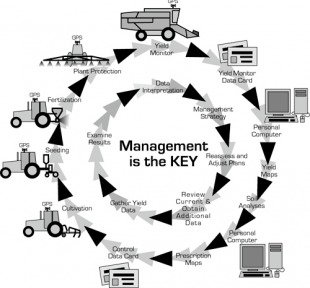
L’aide à la décision combine des compétences en gestion avec des outils traditionnels de PF pour aider les agriculteurs de précision faire les meilleurs choix de gestion ou «ordonnances» pour leur système de production agricole (figure 2). Malheureusement, l’aide à la décision a été à plusieurs reprises peu fiable ou difficile à comprendre. Il faut encore construire des bases de données sur les relations entre les entrées et les rendements potentiels, affiner les outils d'analyse, et accroître les connaissances agronomiques au niveau local. La plupart des chercheurs conviennent que l’aide à la décision reste la région la moins développée de la PF. C’est dans le diagnostic et le développement de bases de données que réside l'avantage réel de la PF.
3. Mise en oeuvre
Selon Frederic Gaspoz, la PF n'est pas appropriée pour tous les domaines. Pour déterminer si un domaine spécifique bénéficiera de PF, il s’agit de suivre les étapes suivantes:
1. Examen des données actuelles. Il s’agit de l’examen des informations existantes, telles que des cartes des sols, des cultures des dossiers pratiques, les caractéristiques historiques, et les cartes qui indiquent les zones de mauvaises herbes et les maladies, humidité. Il faut utiliser des cartes existantes ou des photographies aériennes et tracer des frontières autour des zones ayant des caractéristiques différentes (par exemple le type de sol, le rendement des cultures, ou le pH du sol).
2. Obtenir des données supplémentaires. Plusieurs organismes gouvernementaux ont réalisé des cartes dont les suivantes:
· études de sols numérisées, topologies, routes, limites, graphiques linéaires numériques
Chacune de ces cartes contient des données uniques pour un but précis (par exemple les routes, le type de sol, le contour). La plupart des informations peuvent être acquises à coût faible ou nul.
Obtenir des photographies aériennes récentes de votre ferme. Photographies prises lorsque les champs sont stériles et à deux ou trois stades végétatifs sont particulièrement utiles. Ceux-ci devraient être disponibles à partir de votre bureau local. Utiliser les photos pour identifier les caractéristiques de la propriété connue comme le long des clôtures, des zones de sable, aires de drainage pauvre, l'utilisation du bétail, et d'autres caractéristiques.
3. Recueillir des données sur le rendement. Déterminer la variation du rendement au sein de chaque champ en utilisant un moniteur de rendement. De nombreux capteurs de rendement peuvent être adaptés à votre moissonneuse-batteuse. Parfois, l'achat d'un moniteur de rendement est trop cher ou un moniteur de rendement n'existe pas pour une culture particulière. Dans ces cas, vous pouvez obtenir une estimation du rendement brut de contrôles sur place par les différents domaines du champ avec une pesée.
4. Examiner les résultats. Marquer les zones avec des valeurs de rendement différent sur une photographie aérienne. Un code couleur avec un feutre ou crayon rend plus facile le référencement. Par exemple, utilisez vert pour les zones avec des rendements élevés, jaune pour les zones avec des rendements à moyen et rouge pour les zones à faible rendement. Comparer le rendement de données avec les caractéristiques physiques du terrain et des notes de terrain. Si vous remarquez un modèle de cause à effet, comme une infestation de mauvaises herbes, où les rendements sont réduits, vous aurez probablement besoin d'augmenter votre gestion de cette zone. Vous pouvez collecter des échantillons de sol sur le terrain pour déterminer si les niveaux de nutriments dans le sol limitent le rendement dans les zones les moins productives. Tenir un carnet de notes pour chaque champ qui contient des notes, des photographies et des cartes de la récolte de chaque année.
5. L'interprétation des données. Vous remarquerez peut-être les modes de variabilité uniforme et non uniforme dans le domaine de l'interprétation des cartes de rendement. Utilisez cette information pour évaluer les techniques de gestion et d'autres influences sur la production agricole. Vérifiez les raisons de non-uniformité dans des cartes de rendement par des inspections sur site.
Selon Frederic Gaspoz, il faut utiliser une approche systématique pour stocker des informations lorsque la collecte de données. Faire une copie papier ou électronique de votre information. Stocker cette information dans différents endroits de votre dossier habituel de maintien de zone pour prévenir le vol ou les dommages causés par le feu, l'eau ou une autre catastrophe.
6. Stratégie de gestion. Établir un plan d'action une fois qu'un problème a été identifié. C'est parfois difficile car chaque ferme est unique et une solution prescrite peut ne pas être disponible. Utilisez les services d'un consultant agricole, agent de vulgarisation, ou au spécialiste pour évaluer votre stratégie de gestion.
4. Réévaluation
Les agriculteurs doivent constamment réévaluer avec précision la rentabilité de leur programme de PF. Cela peut être fait en comparant les données du contrôle du rendement aux dossiers financiers pour un domaine spécifique. Si une décision fondée sur le PF n'a pas d'améliorer la rentabilité, un système de gestion plus ou moins intensive PF peut ou ne peut pas être justifiée.
5. Exemples de gestion des cultures spécifiques au site
Développer des stratégies de gestion est la partie la plus difficile du processus de PF. Les agriculteurs de PF doivent tenir compte des étapes de la production des cultures qui peuvent être mieux contrôlées et gérées pour fournir le meilleur rendement économique. Les exemples suivants fournissent un cadre pour l'élaboration d'un plan de gestion des PF. Bien que de nature conceptuelle, ces exemples sont monnaie courante dans les fermes et pourrait être utilisé avec n'importe quelle stratégie de gestion.
Exemple 1. Plan de gestion des éléments nutritifs.
Un agriculteur veut "affiner" ses plans pour la gestion des éléments nutritifs optimaux au rendement économique. Il commence par évaluer les caractéristiques du sol dans un champ. Ensuite, l'agriculteur classe le terrain dans des zones ou «zones de gestion » fondée sur les types de sol communs des cultures. Dans ces zones, l'agriculteur décide de la combinaison de stratégies d'exploitation (par exemple, le labour de conservation avec l'application d'engrais) nécessaire pour obtenir le maximum de profit de ce domaine. Il peut affiner le plan de gestion des éléments nutritifs en fonction des prévisions météo et du marché.
Le travail de réglage fin ne se termine pas à la récolte, note Frederic Gaspoz. L'agriculteur devrait recueillir des données de rendement et des informations sur la quantité de nutriments résiduelle non utilisée par la culture. Il faudrait comparer ces résultats à ses objectifs de rendement et le rendement économique de déterminer si sa décision de gestion est judicieuse.
Exemple 2. Stratégie de gestion pour réduire les coûts des produits chimiques.
Un agriculteur veut économiser de l'argent par l'application de pesticides à la bonne cible, au taux approprié et au bon moment. L'agriculteur choisit un applicateur haute précision équipé de contrôleurs basé sur le GPS. Ensuite, il obtient un dépistage sur le terrain et des données de télédétection des zones d'infestation de parasites dans un champ et ainsi développe une carte géo-référencée. Les services d'une gestion intégrée des ravageurs peuvent être utilisés pour déterminer le moment optimal d'application des pesticides.
L'agriculteur pulvérise uniquement les zones qui ont à la fois un potentiel de rendement élevé et un seuil élevé d'infestation. Les commandes basées sur le GPS font en sorte que ces régions reçoivent le taux d'application approprié. Le contrôleur enregistre également le taux réel, le temps et les données de localisation. Comme dans l'exemple 1, l'agriculteur doit comparer sa moisson avec ses objectifs de rendement et le rendement économique afin de déterminer si sa décision de gestion est judicieuse.
6. Remise en question
Un agriculteur doit constamment poser des questions afin d'optimiser son programme PF. Selon Frederic Gaspoz, il peut s'agir de :
Y a t-il une erreur dans le processus de collecte de données?
Quelle est la précision de l'information?
Qu'est-ce que les informations me disent?
Est-ce que les observations indiquent la variation d'autres influences?
Est-ce que les informations d’une seule année sont suffisantes? (Peu probable)
Puis-je justifier la prise de décision de gestion final sur la base de cette information?
Ai-je besoin d'informations supplémentaires?
Combien de temps et d'argent ai-je dépensé pour la collecte d'informations et prendre des décisions?
7. Conclusion
L’agriculture de précision (PF) est utilisée pour faire varier la gestion de production des cultures à travers un champ. Cette pratique exige des agriculteurs l’utilisation de l'information, la technologie et de l’aide à la décision afin d'accroître le rendement économique. Bien que se lancer dans la PF est assez facile, la prise de décisions de gestion fondées sur des informations PF peut être difficile. Toutefois conclut Frederic Gaspoz, les conseillers agricoles, agents de vulgarisation et des spécialistes sont disponibles pour aider les agriculteurs à mettre en œuvre des programmes de PF.
Frederic Gaspoz